Showing posts with label cold stratification. Show all posts

10/17/13

Mother Nature's Timing


All these tiny seeds from one poppy!
If you've been saving seeds from your own plants, you might have encountered the terminology "cold stratification." This is a process which mimics what Mother Nature does in the wild to control the timing of new seedlings. It is a necessary "pretreatment" for certain seeds (but not for all seeds), which will not germinate otherwise.

Cold stratification subjects the seeds to cold and moist conditions for one to three months (varies with species), either outdoors in the natural environment, or in similar conditions you create indoors. Without this exposure, the seeds will not germinate, so this requirement dictates the timing of next season's growth.

Take wildflowers as an example. If my wild poppies flower in May, I will leave the spent flower on the plant to create seedpods which ripen in late June. The pods bend over and dump hundreds of tiny seeds on the ground. If these seeds were to germinate right away, new young poppy plants would start growing right away and flower again in a month or two. But Mother Nature didn't intend these wild poppies to be flowering again in late summer. To prevent the dropped seeds from germinating immediately, cold stratification is required before wild poppy seeds will germinate. So they must be exposed to winter weather, sitting dormant in the soil before they can germinate and begin to grow the following year. So if I gather those seeds in June, store them in my 60°F basement in an envelope until next spring, they most likely will not germinate when I plant them.

For this reason, I commonly sow my wildflower seeds between September and December, directly on the soil where I want them to grow. I'm not fussy about this, since they'd normally just drop off the plant, so the most I might do is to rake the soil to roughen it, then throw the seeds out of my hand. This is how I scatter my collected wildflower seeds - poppies, black-eyed susan, oxtail daisies, blanket flower, larkspur, columbine, Mexican hat and others. This gives me a great crop of little seedlings in late winter, and they are strong little plants by the time the spring temperatures warm up.

But if you want to harvest and store seeds which require cold stratification - many seed catalogs and other online sources can identify the plants which require this for germination - and plant them early in the next season, you can artificially simulate nature's cold stratification process. Here's how:

Wild Columbine

1) Clean the seeds so no other plant materials (leaves, pods, etc.) are mixed with them

2) Place cleaned seeds in a zip bag with a paper towel or sterile vermiculite or sand, slightly dampened moistened but not so wet that mold will form. A little powdered fungicide can be added.

3) Store the zip bag in the refrigerator, preferably in the veggie/fruit compartment (temperatures from 34 to 41°F are recommended). Do not put in the freezer. Length of time in the fridge varies; do you research online or mimic your winter conditions.

4) Check seeds regularly for fungus or mold or early germination

Read more about cold stratification and about saving heirloom seeds.

8/16/11

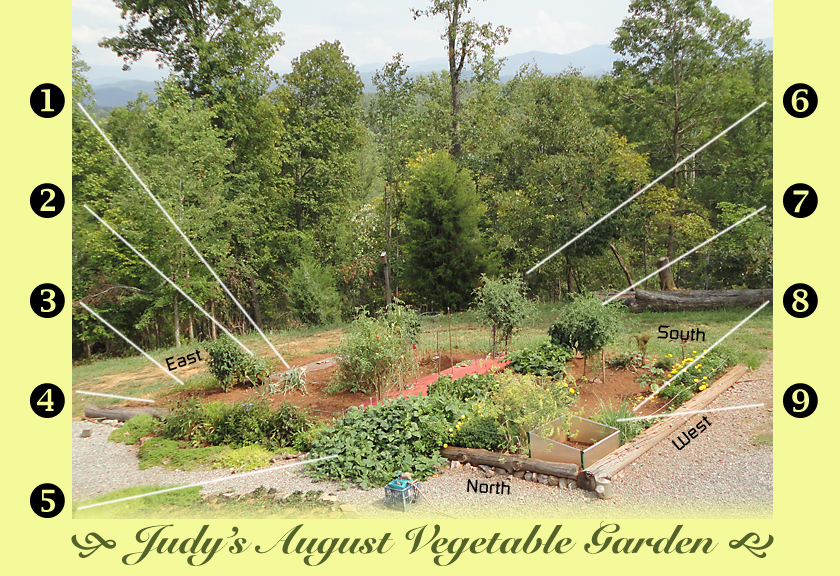
August in the Vegetable Garden


Several people in the last week have asked me if I am "winding down" my gardening season. No way! I'm harvesting continuously, growing late harvest plants, starting more seedlings, and getting ready for new crops when the weather cools. That's one of the pluses about living in Zone 7, with its long growing season.
  1. LEEKS - I just dug my first leek, to use in a stir fry later today. The stalk is about 1" diameter, and there is about 6" of white which is the part that grew below ground - not bad in our heavy clay soil. Don't think I'll grow these again, since I had to baby the seedling for a long period and many did not survive transplanting to the garden. Onions grow better for me.
  2. EGGPLANT - Both plants are producing fruit, but not so many that I am overwhelmed yet. Watch for my upcoming post of a recipe for Eggplant Parmesan - gluten free, low carbs - which is delicious.
  3. SWEET POTATOES - See the close up photos of how the grasshoppers keep defoliating the vines. I have been able to harvest some of the edible leaves  - which taste like mild spinach - when they grow back. Actually, it's a good system, since the new leaves are the most tender, vs. those that might grow on the vines for months.
  4. STRAWBERRIES - I thinned out the strawberry beds, discarding the overgrowth of babies. The main plants don't look very good, our hot weather causing dried brown leaves around the edges, but they are alive and show new growth in the centers. I had a great harvest this past spring from baby plants set out last fall, so I plan to do the same in any bare spots in the bed once our weather cools.
  5. THAI LONG BEANS - Pretty flowers, long vines and a long time for the beans to form. I hope to harvest a good crop very soon.
  6. TOMATOES - I removed the tomato plants most effected by blight and I keep pulling leaves from the lower stems of the remaining plants. So now I have several "topiary" tomato plants. But they are still producing a small crop, which I am happy to have. I've started a few late crop tomatoes again, since the first ones dried up and died in the heat.
  7. PEPPERS - The pointer is to my tall Chinese Giant sweet pepper plant, which, at long last, is producing little green peppers. Also, I took one of my strongest tomato cages and moved it as a support for the larger of my two jalapeno plants, since the branches were getting so heavy with ripening hot peppers. Green jalapenos are sold in markets, but I prefer to pick them when they turn red and black, sometimes with fine ivory veins on the skins.
  8. SQUASHES - I direct sowed seeds of various squash-family plants in July, and now I have a zucchini, 2 cantaloupes, 2 butternut squashes, 2 cucumbers and one casaba melon plant. I am keeping a close eye on them, and whenever I see the little brown egg clusters of the squash beetle I remove the leaf. I occasionally scatter [food grade] diatomaceous earth on the soil around these plants; it's an organic insecticide, an abrasive white powder made from fossilized remains of marine algae. Unfortunately, it washes away with watering and with rain. Every plant is flowering, and I am optimistic that the warm weather will continue so I can harvest these yummy veggies, since my earlier plantings succumbed to pests and disease.
  9. LEMON GRASS - I bought a little pot of Lemon Grass, a strong lemon flavored herb good in a stir fry or tea, and it's thriving in my garden. I am not sure if it will grow as a perennial in my zone; if so, I'll move it to the herb garden.
CELERY - I read of this trick online, and so far it is working: buy a celery stalk, cut about 2" above the bottom, and stick that end in about 1" of warm water for a few days. Soon, new greenery starts to grow from the center. At this point, I set the developing plant in my garden, mounding some soil around it and keeping it moist. It's continuing to grow taller, slowly. The instructions also recommended cutting the top and bottom from a liter bottle, pushing it into the soil around the plant. Otherwise, the stems fall over as they grow taller. Even if I only get celery green tops, it's a fun experiment.
BEANS - While I am waiting for the Long Beans to grow, another small bed of Bush Blue Lake green beans is about ready to harvest. I am giving up on yellow beans. Mine took a very long time to ripen, and the harvest is minimal. I don't think the flavor is as good as green beans either.

FALL GARDENING
After wasting lots of seeds by trying to germinate lettuce in the garden this summer, I learned from the internet that lettuce seeds have a thermal mechanism which tells them not to germinate at temperatures above 70 degrees F. Since our basement stays near 60 degrees year round, I started a big flat of baby romaine and black seeded simpson lettuces a few weeks ago. In two days, they had sprouted! Flats of kale and of brussels sprouts seeds, as well as two varieties of tomatoes, are growing well in the basement south-facing window. I'm also trying a new vegetable - celeriac. It is a big round root, a member of the celery family, very popular in Europe. It has celery flavor and can be stored like a potato. It is recommended as a fall crop, and takes weeks to germinate. So I started its very tiny seeds in a tray indoors also, and I've seen the first 3 seedlings emerge this week. Also, in preparation for fall planting, I have started "cold stratification" of some spinach seeds. This is done by putting the seeds in a small zipper bag with a tiny amount of water, then putting them in the freezer for about a week. Remove from the freezer for a day, then repeat. This method helps the germination of spinach seeds, as well as other seeds, by imitating the freezing and thawing of winter season.